The Key Role of the Gut Microbiota in Alzheimer’s Disease: New Findings from the LTSM Group
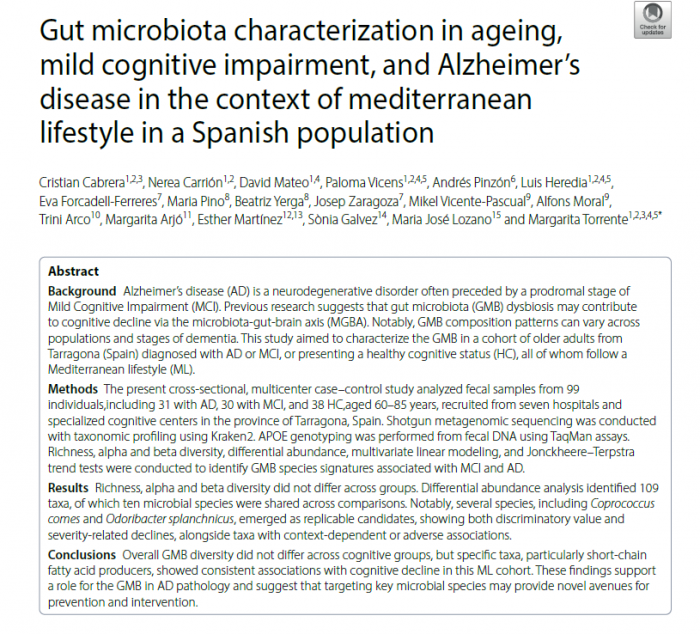
The Neuropsychology and Emotions Area of the LTSM research group (TecnATox, Universitat Rovira i Virgili) has carried out a characterization of the gut microbiota in older adults with normal cognitive functioning, mild cognitive impairment, and Alzheimer's disease, within the context of the Mediterranean lifestyle and in a sample of the Spanish population. Although no overall differences in microbial diversity were observed between the groups, specific bacterial species associated with the degree of cognitive impairment were identified. Particularly noteworthy are certain bacterial species that produce short-chain fatty acids, whose presence progressively decreases from control participants to individuals with Alzheimer's disease. These results provide new evidence on the relevant role of the gut microbiota in Alzheimer's disease.
Reference: Cabrera C, Carrión N, Mateo D, Vicens P, Pinzón A, Heredia L, Forcadell-Ferreres E, Pino M, Yerga B, Zaragoza J, Vicente-Pascual M, Moral A, Arco T, Arjó M, Martínez E, Galvez S, Lozano MJ, Torrente M. Gut microbiota characterization in ageing, mild cognitive impairment, and Alzheimer's disease in the context of mediterranean lifestyle in a Spanish population. Alzheimers Res Ther. 2025 Sep 30;17(1):211. doi: 10.1186/s13195-025-01862-z. PMID: 41029837; PMCID: PMC12482474.
Related elements
Share